

Boston, Massachusetts — A long-running news website that covers Dungeons and Dragons products and events has been unmasked as an AI-generated engagement mill, ILL OMENS has learned.
The site—which has been shared all over social media sites like Facebook and Reddit as early as 2022—goes by “dungeonsanddragonsfan.com,” and has been accused of using AI platforms to generate a bulk of its many articles, product reviews, and even the credentials of its alleged contributors.
Content found on D&Dfan typically includes glowing, favorable reviews and “sneak peeks” of Wizards of the Coast (WOTC) products. They also operate a weekly newsletter and host “top 10 product lists,” a format that has become synonymous with AI and Google SEO manipulation.
An “about us” page found on the site claims it was originally established by friends to cover the “world’s greatest roleplaying game.”
“Like all great adventures, D&D Fanatics started out in a tavern, when over beers a group of likeminded friends decided to make their own website to share their love of table top RPGs,” read the site. “Our goal is to offer the latest news and reviews when it comes to Wizards of the Coast’s Dungeons & Dragons. From new game books to the latest accessories and rules updates, we cover everything related to (Dungeons and Dragons.)”
D&DFan’s façade of legitimacy began to unravel after internet sleuths discovered that the formatting and passive language of their articles sounded eerily close to something churned out by large language model AIs like ChatGPT or Claude. These suspicions only grew after the identities of the so-called “journalists” behind these articles were also suspected of being fake.
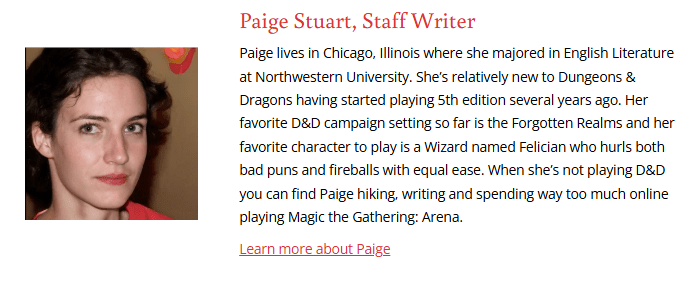
According to D&DFan’s “About Us” page, the website currently has five in-house contributors, including “Senior Editor” Cameron Nichols of Boston Massachusetts, Journalism major Ollie Delano of Chicago, Illinois, English Lit major Paige Stuart (also from Chicago), as well as “publisher” and TTRPG veteran Jason Volk, who allegedly lives in Canada.
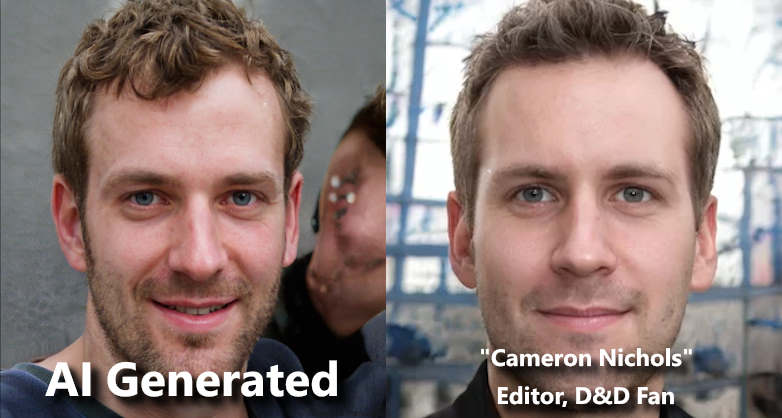
“(Cameron Nicols) lives in Boston, Massachusetts, and has been playing Dungeons & Dragons and table top RPGs since the early 1990s, when he was introduced by his older brother and cut his teeth on AD&D 2nd Edition,” read a somewhat believable bio for the website’s top contributor. “Since then he’s played virtually every RPG he could get his nerdy little mitts on (including a weird Goth phase in the early 2000s when he rocked Vampire: The Masquerade pretty hard).”
“As a Dungeon Master (he) has been running a D&D 5th Edition campaign with the same group for over 5 years. His favorite D&D campaign setting is the Forgotten Realms and his favorite character to play was a Half-Orc Barbarian named Grug (who was unfortunately devoured by a gelatinous blob). You can find him hanging out with his wife Melissa and their bulldog Bruenor,” it continued.
While at first glance this blurb might sound real, Google search results for a “Cameron Nicols” of Boston, Massachusetts or any of the so-called “credentialed” journalists at D&DFan only produced redirect links back to the dungeonsanddragonsfan.com about us page.
Additionally, headshots provided by the site for each of these personas appear directly ripped from the popular AI website thispersondoesnotexist.com, which produces photorealistic images of people that, as the name suggests, don’t actually exist. Facial recognition searches performed by ILL OMENS for any of the alleged journalists could also not produce any genuine results.
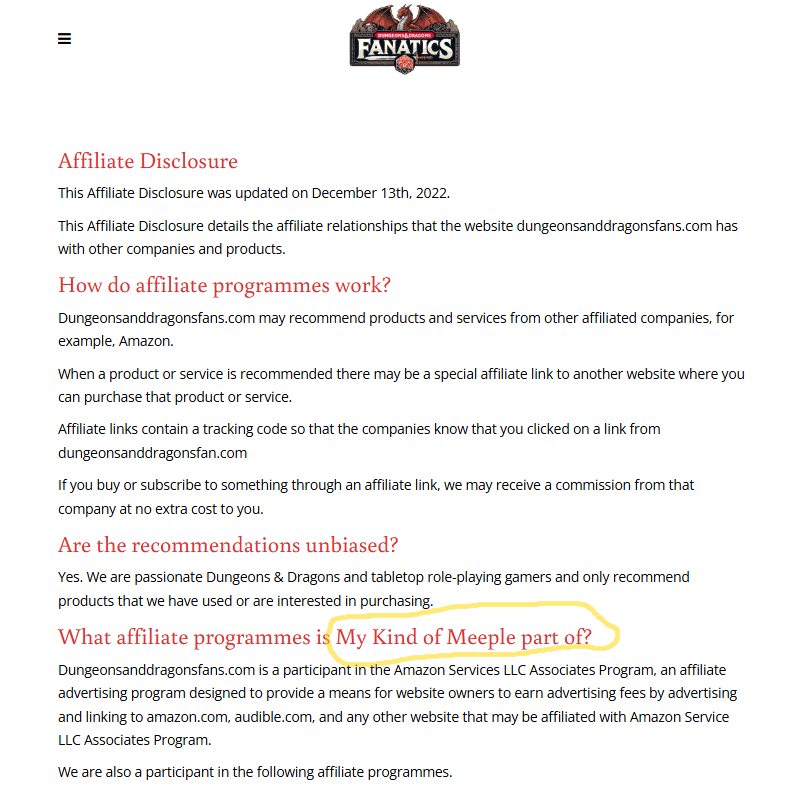
The final nail in the coffin for D&DFan came when internet users discovered that D&DFan plagiarized its “Affiliate Disclosure” notice from “My Kind of Meeple,” a completely different board-gaming website.
When copy/pasting the disclosure notice for its own use, D&DFan failed to remove text containing the other website’s name, and the name “My Kind Of Meeple” can still be seen on D&DFan’s Disclosure Notice. This glaring issue has yet to be rectified at the time of press.
“Dungeonsanddragonsfan.com is completely AI-generated, from the articles and contributor headshots, to their fake credentials and bios,” read a post from one Reddit user. “If you don’t believe me, take a look for yourself. Everyone listed here is/was picked from the “thispersondoesnotexist” generator, and their backgrounds are as fictional as a D&D character sheet.”
Since its explosion in popularity in recent years, free, easily accessible AI platforms have become a powerful double-edged sword in the gaming world. Their ability to generate ideas and visual content have even paved the way for apps like the controversial Everweave, an AI tool which boasts its ability to run or “dungeon master” a game of D&D for players entirely by itself.
However, critics of AI have railed against the use of AI in the TTRPG space, attacking it as a cheap and uninspired method exploited by lazy players or creators. AI is also believed to harm those who put time and effort into their work, and view these platforms as a way to undercut them at the online marketplace with AI-generated slop content.
The use of AI in the TTRPG industry grew so prolific, that in 2023, even WotC itself had to ban its illustrators from using it to inform or influence their designs.
ILL OMENS reached out to D&DFan via email for comment regarding its alleged use of AI on its website, but did not hear back in time for a response. This story is developing and will be updated as new information comes to light.
 Ill Omens